



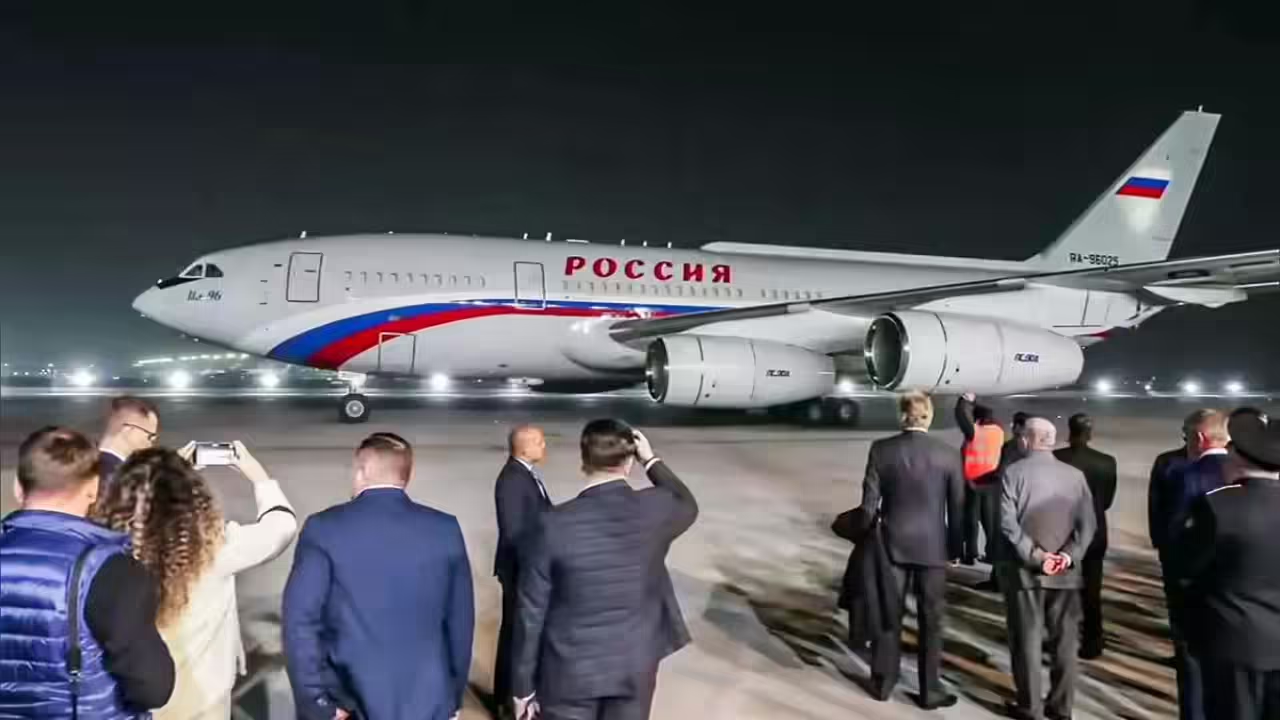
Putin’s ‘Flying Kremlin’: Inside the Airborne Palace and Command Center That Brought the Russian President to Delhi
When Russian President Vladimir Putin landed in Delhi for his high-profile talks with Prime Minister Narendra Modi, global attention naturally gravitated toward the geopolitical agenda. Yet, it wasn’t Putin’s statements that dominated conversations online—it was the aircraft that carried him. The specially-built Russian presidential jet, often called the “Flying Kremlin,” sparked fascination once again, reminding the world that it is far more than a mode of travel. It is a floating command center, a secure fortress, and a symbol of Russian technological identity.
More Than a Plane: An Airborne Kremlin
Putin travels in the Ilyushin IL-96-300PU, a heavily customized version of the IL-96 airliner, built entirely in Russia. The suffix “PU” stands for Punkt Upravleniya, meaning Command Post, a clear indicator that the aircraft’s core purpose is national leadership, not luxury travel.
Unlike other world leaders who rely on American Boeing or European Airbus platforms, Putin’s aircraft showcases Russia’s insistence on aerospace self-reliance. The Kremlin considers this jet an extension of its strategic infrastructure—capable of supporting governance even during the most extreme global crises.
A Mobile Command Center for Wartime and Peace
What sets the Flying Kremlin apart is its suite of military-grade systems. The plane is engineered to function as a full command center in the sky, able to issue military directives—including nuclear command signals—regardless of where it is in the world.
Key capabilities include:
- Encrypted satellite communication systems that remain protected from interception.
- Global military network access, ensuring the president can stay linked to armed forces and intelligence agencies at all times.
- Advanced electronic countermeasures, including radar jammers, spoofing systems, and infrared decoy launchers to misguide incoming missiles.
- Protection against electromagnetic pulse (EMP) attacks, a rare but strategically vital feature meant to preserve operability during nuclear-level events.
- Hardened avionics and systems, designed to function even under cyber or electronic warfare attempts.
With a range of nearly 11,000 kilometers, the aircraft can fly intercontinental missions without refuelling, allowing the presidency—and by extension, the Russian state—to function uninterrupted in emergencies.
A Palace in the Clouds: Interiors Designed for Power
If the aircraft’s exterior suggests toughness, its interior reveals opulence. The IL-96-300PU is crafted to replicate the comfort and prestige of a presidential residence. Every detail is designed to support long-duration travel, high-level decision-making, and diplomatic engagements.
Reported interior highlights include:
- A private presidential suite equipped with a spacious bedroom for rest during long missions.
- A fully functional office, enabling Putin to review documents, hold discussions, and respond to events in real time.
- A large conference hall, resembling a high-level boardroom, where airborne meetings or strategic briefings can be conducted.
- Comfortable guest lounges for ministers, advisors, and security officials.
- High-grade woodwork, gold-toned décor, luxurious upholstery, and premium finishes that make the cabin resemble a government palace more than an airliner.
- A medical unit, ensuring immediate response capability for health emergencies.
This blend of comfort and state functionality underscores the aircraft’s unique identity: it is both a palace and a war-room, a symbol of state elegance and hard power.
Symbolism, Strategy, and Russian Aerospace Pride
Putin’s Flying Kremlin is not merely a transport aircraft—it is a strategic asset. By choosing a domestically produced presidential jet, Russia asserts its independence from Western aerospace giants. The aircraft also serves a deeper purpose: projecting an image of robust statehood, military capability, and national technological pride.
For Russia, the IL-96-300PU represents:
- Continuity of government, even in the most exceptional global crises.
- A deterrence symbol, emphasizing that leadership and command structures remain unbroken anywhere in the world.
- A showcase of domestic engineering, reinforcing Russia’s position as a nation capable of designing advanced aviation platforms for strategic leadership.
Conclusion
Putin’s arrival in Delhi once again spotlighted one of the world’s most secretive and technologically fortified aircraft. The Flying Kremlin stands at the intersection of power, prestige, and preparedness—a rare synthesis of luxury and military readiness. Whether viewed as a palace in the sky or an airborne command bunker, the IL-96-300PU remains one of the most fascinating presidential aircraft in modern geopolitics.
Also Read:
Tom Cruise: A Legendary Journey in Hollywood
Dwayne Johnson Biography: The Rock’s Journey from WWE to Hollywood Stardom
Kiara Advani Give Birth to a Baby Girl
Pawan Kalyan’s Hari Hara Veera Mallu is set to Release on 24th of This month
Sitaare Zameen Par Full Movie Collection
Indian team asked to stay indoors in Birmingham after security alert


