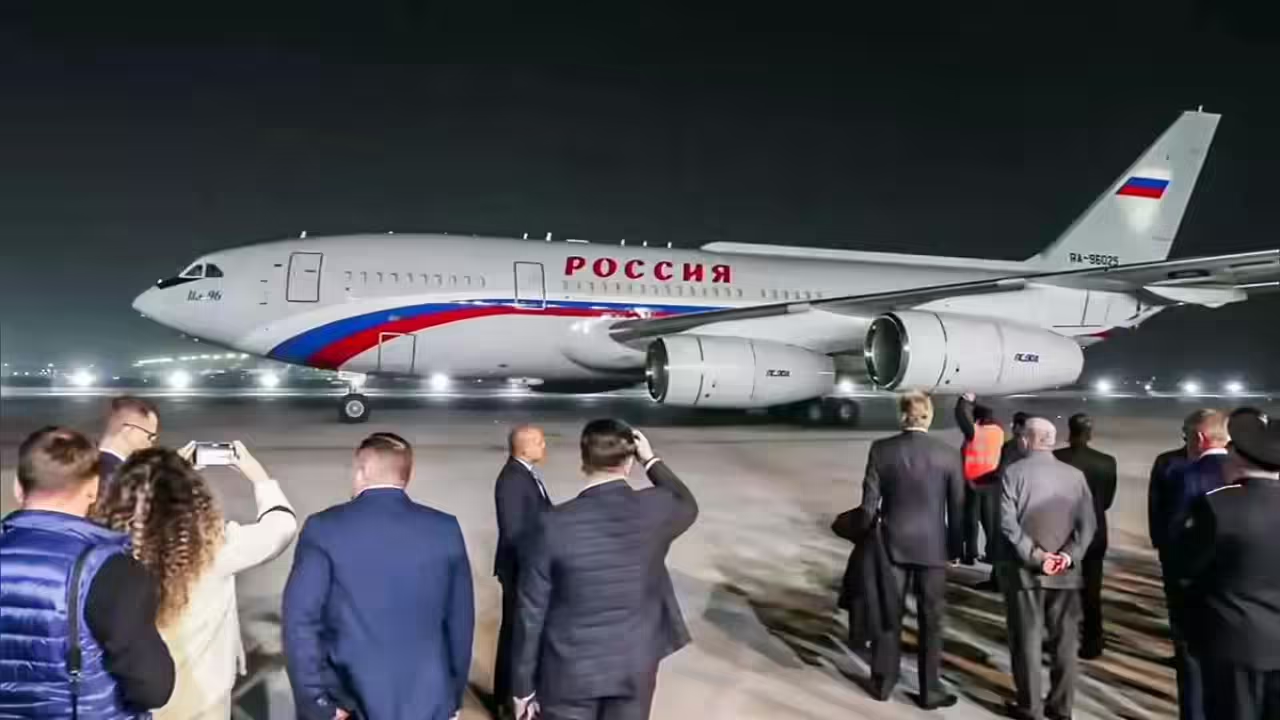


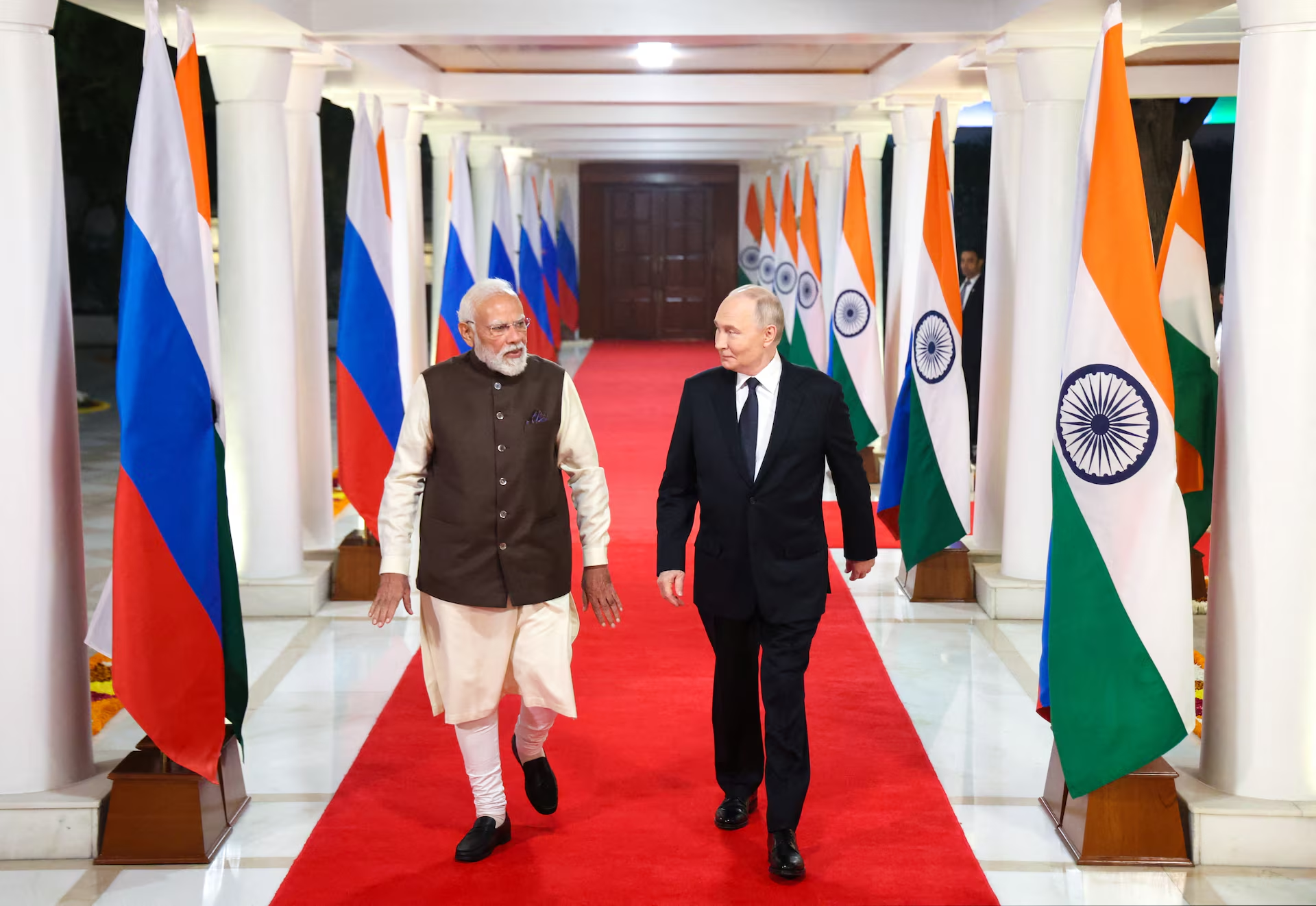
The 23rd India-Russia annual summit held in Delhi has once again breathed new life into the relations between the two countries. Prime Minister Narendra Modi has made it clear that despite the changes in the world situation in the last two decades, the bond between India and Russia has only grown stronger. In the extensive discussions with President Putin, it was decided to further expand cooperation in several key areas such as trade, investment, connectivity, energy and critical minerals.
India-Russia diplomatic relations have a special place in history. The 23rd India-Russia Annual Summit was a platform to further strengthen that relationship. In this meeting between Prime Minister Narendra Modi and Russian President Vladimir Putin, extensive discussions were held on cooperation between the two countries. From the economic sector to energy security… from education to skill development… from maritime transport to critical minerals.. the leaders had in-depth discussions on all issues. The main attraction of this meeting was the approval of the economic cooperation program by both countries, which will be in force until 2030. These agreements will set the direction for further expanding India-Russia trade and investment relations.
“Agreement has been reached on an economic cooperation program to be implemented until 2030. We want to expand trade and investment relations between the two countries. From shipbuilding to skill development, we will move forward together in many areas,” Modi tweeted.
The foundation of India-Russia friendship is people-to-people ties. The recent opening of two new Indian consulates in Russia and the return of sacred Buddhist relics to Russia have given a new impetus to the cultural ties between the two countries. Prime Minister Modi said that there is a lot of scope for enhancing cooperation in the fields of education, skill development and training.
Prominent global issues also figured prominently in the discussions. Modi reiterated India’s commitment to a peaceful and long-term resolution to the Ukraine-Russia war. The two countries also agreed to work together to counter terrorism and continue their cooperation in several multilateral fora. “India and Russia must work together to combat terrorism. No one can face this threat alone,” Modi said.
Overall… The Putin-Modi meeting further strengthened the India-Russia strategic partnership. The summit once again sent a message to the world that the Moscow-Delhi relationship is unwavering, even amid global political developments.
The summit took place on 4–5 December 2025 in New Delhi, as part of a two-day state visit by Vladimir Putin to India, at the invitation of Narendra Modi.
The summit meeting was held at Hyderabad House in Delhi, with accompanying ceremonial events (welcome at Rashtrapati Bhavan, homage at Rajghat, formal dinner, etc.) as part of the state visit protocol.
Key Themes & Focus Areas
The summit reinforced the long-standing “Special and Privileged Strategic Partnership” between India and Russia, with several major domains of cooperation on the agenda.
Trade & Economy
The two sides launched an Economic Cooperation Programme through 2030, aiming to significantly ramp up bilateral trade.
Discussions included diversifying trade beyond traditional sectors; promoting Indian exports (agriculture, pharmaceuticals, textiles), industrial cooperation, technology and investment partnerships.
To facilitate smoother trade, both countries agreed to work on bilateral settlements using national currencies, besides exploring interoperability of national payment systems, financial messaging systems and even CBDC platforms.
Energy, Nuclear & Critical Technologies
Energy cooperation remains central — cooperation envisaged in oil, petrochemicals, natural gas (LNG/LPG), upstream technologies, oilfield services.
Civil nuclear cooperation is also emphasized: support for ongoing projects like Kudankulam Nuclear Power Plant, expansion of nuclear-power cooperation, fuel cycle, life-cycle support, and new high-tech collaboration.
The summit highlighted interest in cooperation on “critical minerals and rare earths,” and in advanced manufacturing, processing and recycling technologies — reflecting longer-term strategic technology/industrial collaboration.
Defence and Military-Technical Cooperation
Defence cooperation continues to be a cornerstone. But the focus is shifting: away from simply buyer-supplier towards joint research, co-development and co-production of advanced defence technologies and systems, under the banner of “Make in India” and localized manufacturing.
The military-technical cooperation framework (under the IRIGC‑M&MTC) was reaffirmed, building on its 22nd session held just before the summit.
The modernization and maintenance of existing Russian-origin equipment in Indian forces — through joint ventures producing spare parts, components, aggregates — was given importance. This also covers the possibility of third-country exports.
Connectivity, Arctic/Far East Engagement & Logistics
India and Russia agreed to deepen cooperation in Russian Far East and Arctic regions (including maritime transport, mining, agriculture, energy, critical minerals, pharmaceuticals, etc.) under a cooperation programme (2024-2029).
They also envisage enhancing connectivity — including exploration of Northern Sea Route, maritime routes, possibly corridors linking India with Russia’s Far East / Arctic — which could reduce freight costs and open new trade routes.
Multilateralism, Global & Security Cooperation
Both countries reaffirmed cooperation in multilateral forums — including BRICS, Shanghai Cooperation Organisation (SCO), UN, G20 — emphasising shared global outlook.
On security & counter-terrorism: they condemned terrorism in all forms, committed to concerted action against terrorism, terror financing, cross-border crime, extremism, and strengthening cooperation for global security and stability.
What They Announced / Agreed To — Outcomes of the Summit
16 agreements / MoUs were signed across fields: trade & economy, defense cooperation, nuclear & energy, labour mobility, critical minerals, connectivity/transport, cultural/academic exchanges and more.
A commitment to boost bilateral trade towards US$ 100 billion by 2030, significantly raising ambition beyond current levels.
Decision to proceed with developing bilateral (non-USD) payment and settlement mechanisms, to facilitate trade resilience despite global financial/tariff pressures.
Commitment to joint defence R&D, co-production and technology transfer, reducing dependence solely on imports — aligning with India’s push for self-reliance in defense manufacturing.
Agreements on nuclear energy cooperation, clean energy, critical-minerals collaboration, and expansion into sectors like maritime, shipping, railways, high-tech industries, agriculture, etc.
Geopolitical Context & Significance
This summit is happening against the backdrop of ongoing global upheavals: after the war in Ukraine, global sanctions on Russia, and growing pressure (especially from Western powers) on countries continuing trade with Russia — especially energy. The summit signals that India and Russia intend to sustain and deepen ties despite external pressures.
For India, the move underscores its commitment to strategic autonomy — balancing relationships with multiple global powers rather than aligning strictly with any side.
The expansion beyond oil/defence — into trade diversification, critical minerals, energy cooperation, technology, connectivity — signals a shift toward a more balanced, future-ready partnership along broader economic, strategic and industrial lines.
Also Read:
Tom Cruise: A Legendary Journey in Hollywood
Dwayne Johnson Biography: The Rock’s Journey from WWE to Hollywood Stardom
Kiara Advani Give Birth to a Baby Girl
Pawan Kalyan’s Hari Hara Veera Mallu is set to Release on 24th of This month
Sitaare Zameen Par Full Movie Collection
Indian team asked to stay indoors in Birmingham after security alert